Skip to content

Understanding Possession and Access for Houston Families
Key Takeaways: Yes, the Expanded Standard Possession Order applies to Houston parents because it is part of the statewide Texas Family Code framework. The Standard Possession Order is the default schedule courts use to divide parenting time, while the expanded terms extend key start and end times, typically running weekends from school release Friday until school resumes Monday and lengthening Thursday periods. For parents living 50 miles or less apart in cases filed on or after September 1, 2021, the expanded terms apply automatically unless the possessory conservator opts out or a court finds an exception; for parents living more than 50 but within 100 miles, the noncustodial parent must elect them. Distance determines which options are available, and every order must include mandatory notice provisions under Texas Family Code § 105.006.
Yes, the Expanded Standard Possession Order applies to Houston parents because it is part of a statewide framework built into Texas law. In Texas, "visitation" is legally called possession and access, and the Standard Possession Order has served as the baseline schedule since 1995. Harris County parents fall under the same Texas Family Code that governs the rest of the state, making the expanded version available here subject to distance rules and the child’s best interest.
If you are working through a separation, divorce, or modification of parenting time, the team at Angela Faye Brown & Associates can help you understand how these schedules apply to your family. Call 713-936-2677 or reach out through our contact page to discuss your parenting plan.
What the Standard Possession Order Actually Is
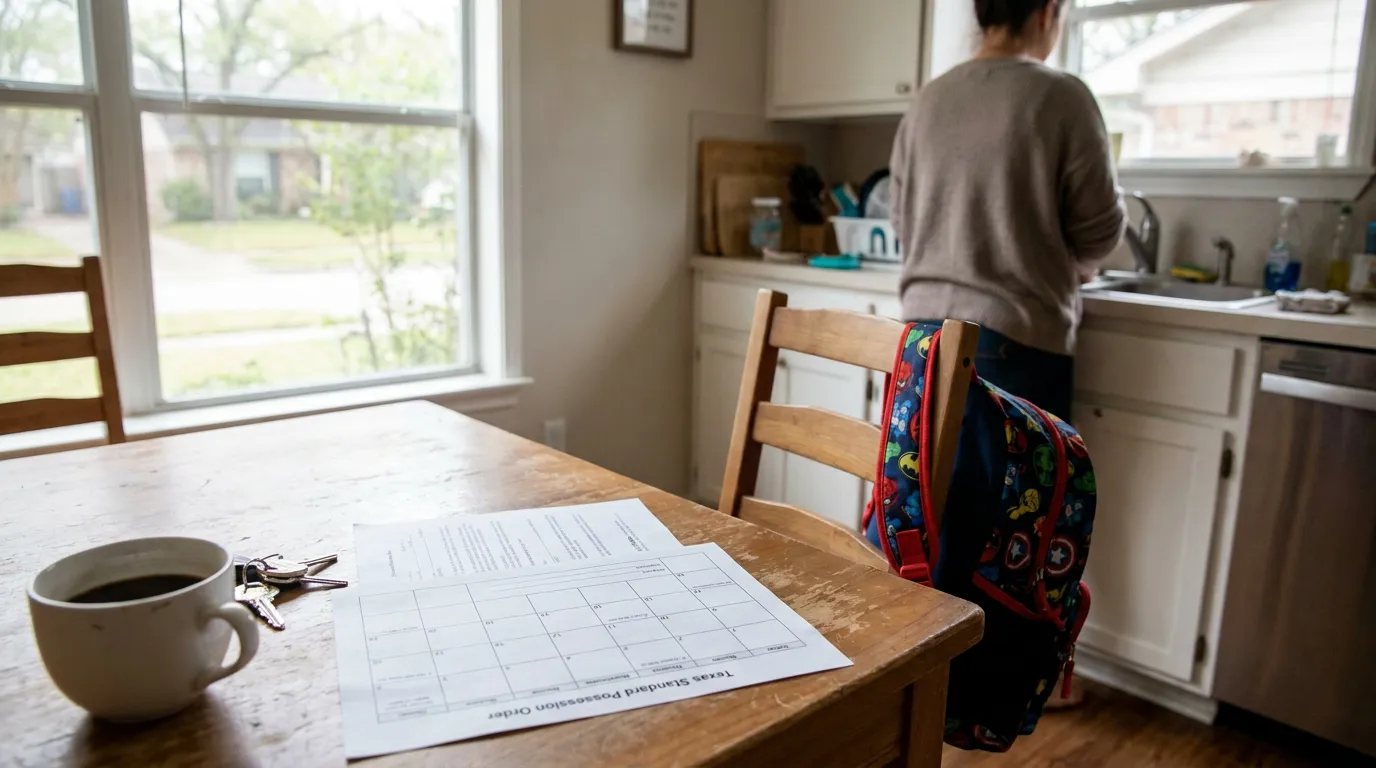
The Standard Possession Order is the default schedule Texas courts use to divide parenting time between conservators. Texas Family Code § 101.029 defines it as an order that gives a parent rights of possession under the terms and conditions of Subchapter F, Chapter 153.
The actual times, conditions, and election options are found in Subchapter F of Chapter 153. Parents often read the definition expecting to find the schedule there, but the details are located separately. You can review the full framework in Subchapter F of Chapter 153, where the standard and expanded terms are set out.
💡 Pro Tip: When you receive a proposed order, read the specific paragraphs describing pickup and drop-off times. The label "standard" tells you the category, but the numbered provisions control what actually happens.
The Expanded Standard Possession Order Texas Parents Should Know
The expanded standard possession order Texas families use is a modification of the baseline schedule under Texas Family Code § 153.3171 and § 153.317. For a possessory conservator living 100 miles or less from the child’s primary residence, the standard schedule generally provides possession on the first, third, and fifth weekends from Friday at 6 p.m. to Sunday at 6 p.m., plus Thursday evenings during the school term from 6 p.m. to 8 p.m. The expanded terms extend those times, typically beginning possession when the child is released from school Friday and ending when school resumes Monday morning. For parents living 50 miles or less apart in cases filed on or after September 1, 2021, § 153.3171 makes these expanded times the default unless the possessory conservator opts out or the court finds an exception; for parents living more than 50 but within 100 miles, the noncustodial parent must elect the expanded times under § 153.317.
This expansion meaningfully increases parenting time for a noncustodial parent without changing the underlying weekend structure. Instead of a Sunday evening return, the child stays through Monday morning, and the Thursday period can extend from after school to Friday school start. Our related discussion of the expanded standard possession order Texas provides additional context for parents evaluating their options.
Distance between the parents’ homes is the threshold factor that determines which options are available. The Texas Attorney General notes that possession options change based on how far parents live from one another. You can compare schedules on the official parenting time schedule resource.
How Houston Parents Choose or Trigger the Expanded Schedule
Whether the expanded schedule is elected or applies automatically depends on how far apart the parents live. For parents living more than 50 but within 100 miles, the noncustodial parent selects between the default and election schedule when the order is completed. For parents living 50 miles or less apart in cases filed on or after September 1, 2021, the expanded times apply automatically unless the conservator opts out or the court finds an exception. Where an election is required and none is made, the default terms may be placed in the order.
Courts must also honor the parents’ own agreements before the statutory schedule takes over. Under Texas Family Code § 153.311, the order must state that parties may exercise possession at times they mutually agree to in advance, and the statutory schedule controls only when there is no agreement. This built-in flexibility rewards cooperative co-parents.
Common ways the expanded terms may apply:
- The noncustodial parent formally makes the election when the order is drafted.
- Both parents mutually agree in advance to times that mirror the expanded schedule.
- A court incorporates the expanded terms after weighing the child’s best interest.
💡 Pro Tip: Put agreed schedule changes in writing, even by text or email, so both parents share the same expectations and have documentation if disputes arise.
Why the Statute Backs Up the Schedule
The schedules carry legal weight because they flow directly from statute rather than informal practice. The Family Code defines "school" for purposes of determining pickup and drop-off, generally meaning the elementary or secondary school where the child is enrolled or the public school district where the child primarily resides. This statutory definition helps parents avoid disputes over what "when school is released" actually means.
When a court orders a schedule that varies from the standard order in a contested case, a party may request written reasons. Under Texas Family Code § 153.258, if possession is contested and varies from the standard order, the court shall, on request by a party, state in writing the specific reasons for the variance. This protection helps parents understand or potentially challenge why a different schedule was imposed.
💡 Pro Tip: If your contested case results in something other than the standard or expanded schedule, ask your attorney about requesting written reasons before the order is finalized.
Notice Requirements That Come With Every Order
Every Texas possession order, including one incorporating expanded terms, must contain mandatory notice language. Under Texas Family Code § 105.006, each party is ordered to notify the other party, the court, and the State Case Registry of any change in residence address, employer, phone number, or driver’s license number. This requirement applies statewide and is not optional.
For an intended move or change in contact information, the statute generally calls for advance notice on or before the 60th day before the change. Failing to follow these notice rules may result in enforcement litigation, contempt of court, potential jail time, fines, and payment of the other party’s attorney’s fees. Parents should treat these provisions as routine compliance rather than fine print.
| Feature | Standard Schedule | Expanded Election |
|---|---|---|
| Weekend start | Friday 6 p.m. | When school is released Friday |
| Weekend end | Sunday 6 p.m. | When school resumes Monday |
| Thursday period | 6 p.m. to 8 p.m. | After school to Friday school start |
| Distance rule | 100 miles or less | 50 miles or less (automatic); 51-100 miles by election |
These schedules are starting points, and outcomes depend on each family’s specific facts. Courts retain discretion to depart from any schedule when the arrangement is not in the child’s best interest. Parents navigating Houston child custody matters often benefit from mapping out school calendars and travel logistics before finalizing terms.
Frequently Asked Questions
1. Is the expanded schedule automatic in Houston?
It depends on how far apart the parents live. For parents living 50 miles or less apart in cases filed on or after September 1, 2021, the expanded terms apply automatically unless the conservator opts out or the court finds an exception; for parents living more than 50 but within 100 miles, the noncustodial parent must elect the expanded terms.
2. Does the 100-mile rule affect my options?
Yes, distance is a threshold factor. The expanded terms under Texas Family Code § 153.3171 apply automatically when a parent lives 50 miles or less from the child’s primary residence unless the conservator opts out; for parents living more than 50 but within 100 miles, the expanded times are available by election under § 153.317.
3. Can my co-parent and I agree to a different schedule?
Yes, in many cases you can. Texas Family Code § 153.311 requires the order to allow possession at times mutually agreed to in advance, and the statutory schedule controls only when there is no agreement.
4. What happens if I move without giving notice?
Failing to give required notice carries real consequences. Under Texas Family Code § 105.006, noncompliance may lead to enforcement litigation, contempt of court, and other penalties, so advance notice is strongly advisable.
5. Can I ask why the court chose a different schedule?
Yes, under certain circumstances you may request written reasons. Texas Family Code § 153.258 allows a party to request that the court state in writing its specific reasons for varying from the standard order in a contested case.
Bringing It Together for Your Family
The expanded schedule is available to Houston parents because it is part of the statewide Texas framework, subject to the distance rule, the election or automatic-application process, and the child’s best interest. The Standard Possession Order sets the baseline, the expanded terms extend key start and end times, and mandatory notice provisions apply to every order. Because each case turns on its own facts, the schedule that fits one family may not fit another.
If you are ready to build a schedule that reflects your child’s needs, the team at Angela Faye Brown & Associates is prepared to guide you through your options. Call 713-936-2677 or request a time to connect with our team to take the next step toward a workable parenting plan.